
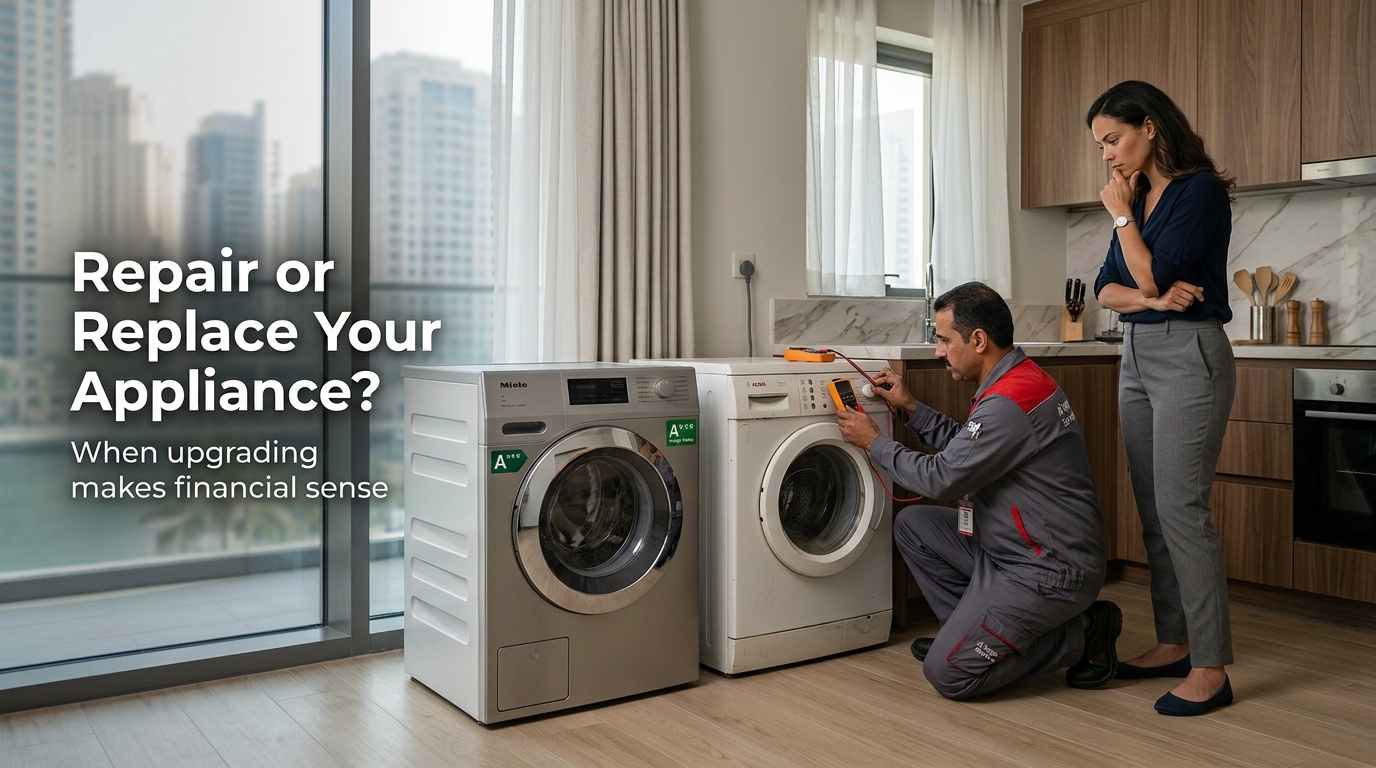
An appliance breaks down, a repair technician quotes you a price, and suddenly you’re doing mental math: is this worth fixing, or should I just replace it? It’s a common moment, and the answer isn’t always obvious, since a repair that seems expensive in isolation might still be the cheaper option once you compare it against buying new.
This article lays out a practical way to make that call, the factors that actually matter, and how brand and repair-parts availability using Smeg and Samsung washing machines as examples can shift the answer even for appliances of similar age.
The Quick Rule of Thumb
A commonly used guideline: if a repair costs more than 50% of the appliance’s current replacement value, replacing it is usually the more sensible financial choice.
This isn’t an absolute rule it’s a starting point. An appliance nearing the end of its typical lifespan tips toward replacement even at a lower repair cost, while a relatively new appliance can be worth repairing even above that threshold, since it still has years of use left.
Typical Appliance Lifespans
Knowing roughly where your appliance sits in its expected lifespan helps put any repair quote into context.
| Appliance | Typical Lifespan | Notes |
| Washing machine | 8–12 years | Motor and drum typically outlast smaller components |
| Refrigerator | 10–15 years | Compressor failure late in life often signals replacement |
| Air conditioner | 8–12 years | Efficiency drops noticeably in the final years |
| Dishwasher | 8–10 years | Pump and seal issues become more frequent with age |
| Cooking range/oven | 10–15 years | Gas components often outlast electronic controls |
A washing machine at year 3 with a broken door seal is a very different decision than the same model at year 10 with a failing motor.
The Factors That Actually Matter
Repair Cost vs. Replacement Cost
This is the core comparison, but it needs a fair baseline compare the repair quote against the cost of a comparable replacement, not against the price of an upgrade to a much higher-tier model.
Age and Remaining Lifespan
A repair on a 3-year-old machine is a different bet than the same repair on a 10-year-old one, since you’re paying for a shorter remaining lifespan in the second case.
Frequency of Past Repairs
An appliance that’s needed two or three repairs in the past year is signaling something beyond a single isolated fault continuing to repair it usually means paying again soon.
Parts Availability
This is where brand matters more than people expect. Widely sold, well-serviced brands typically have parts available quickly and at lower cost. Less common or premium-import brands can mean longer wait times and higher part costs, even for a comparable repair.
Energy Efficiency Gains
A washing machine from 10+ years ago will generally use noticeably more water and electricity per cycle than a current model, which is a real ongoing cost that a repair quote alone doesn’t capture.
A Real-World Example: Smeg vs. Samsung Washing Machines
Brand affects this decision in a concrete way, and these two brands illustrate it well.
Samsung washing machines sold in the UAE models like the WW90CGC04DABGU (9 kg, EcoBubble) or the WW11BB944DGBGU (11.5 kg, Bespoke AI Series 8 with AI Wash) come from a brand with an extensive local service network and widely stocked parts, since Samsung appliances are common across the region. Samsung also backs the digital inverter motor on many current models with a long warranty period (commonly 10 years, and up to 20 years on some models), which means the single most expensive component to replace is often covered well beyond the machine’s early years. For a Samsung machine, a repair quote for something other than the motor is frequently well under the 50% threshold, making repair the more straightforward choice for a mid-life machine.
Smeg washing machines, such as the LB2T92GA (9 kg, 1200 RPM, inverter motor) sold in the UAE, come from a design-focused Italian brand with a smaller service footprint locally compared to Samsung. Parts for a Smeg machine may need to be sourced from a smaller pool of authorized technicians, which can mean a longer wait and a higher labor cost for a comparable repair, even when the part itself isn’t dramatically more expensive. This doesn’t mean a Smeg machine isn’t worth repairing it often is, particularly given its design and build quality but the repair-vs-replace math can tip toward replacement sooner than it would for an equivalent-age Samsung machine, simply due to service accessibility.
The lesson here generalizes beyond these two brands: check how easily serviced your specific brand is in Dubai before assuming a repair quote reflects what you’d pay for the same fault on a different brand. A quick way to check this in practice is to ask the repair technician directly how often they service that brand and whether parts are kept in stock locally or need to be ordered the answer alone often tells you more about likely turnaround time than the quoted price does.
Common Repair Costs by Component
Not all repairs carry the same weight in the replace-vs-repair decision. Some components are relatively inexpensive and quick to fix, while others approach a significant fraction of the machine’s value on their own.
| Component | Relative Repair Cost | Typical Impact on Decision |
| Door seal / gasket | Low | Almost always worth repairing |
| Drain pump | Low to moderate | Usually worth repairing unless the machine is very old |
| Control board | Moderate | Worth weighing against machine age |
| Drum bearing | Moderate to high | Often a turning point toward replacement on older machines |
| Motor | High | Frequently approaches or exceeds the 50% threshold, especially without a warranty |
This is why two repair quotes for “the same problem” can lead to different decisions — a control board fault on a 3-year-old machine is a straightforward repair, while the same fault on a 10-year-old machine of the same original price is a much closer call.
How to Get an Accurate Picture Before Deciding
Before committing to either option, a few steps help make sure you’re comparing like with like:
- Get the actual repair quote in writing, including parts and labor, rather than estimating from memory of what a similar repair once cost.
- Check your appliance’s original purchase price and age, since the 50% guideline only works against a realistic replacement cost for a similar-tier model, not a downgrade or upgrade.
- Ask whether the fault is likely to recur or affect other components soon, since a technician can often flag this during the same visit.
- Check if any part of the repair is still under warranty, particularly for major components like the motor, since this can change the math entirely.
A Note on Warranty Coverage
Warranty terms are one of the most overlooked factors in this decision. A machine with a 10-year motor warranty, like several current Samsung models sold in the UAE, effectively removes the single most expensive potential repair from the equation for a decade, which shifts the replace-vs-repair balance heavily toward repair for any other fault during that period. Once that warranty period ends, though, the calculation reverts to a standard comparison based on the appliance’s age and the specific repair needed the warranty doesn’t extend the appliance’s overall expected lifespan, just the affordability of one particular kind of failure within it.
Beyond the Numbers: Practical Considerations
The financial calculation is the core of this decision, but a few practical factors are worth weighing alongside it.
How much do you rely on the appliance daily?
A washing machine that’s out of commission for a week or two while waiting on an imported part, as can happen with less commonly serviced brands, has a real inconvenience cost that isn’t captured in a repair quote particularly for a larger household.
Are you planning to move or renovate soon?
If a move is already on the horizon, it may be worth timing an upgrade around it rather than repairing an aging appliance now and replacing it again shortly after arriving somewhere new.
Does the appliance still meet your household’s needs?
Sometimes the decision isn’t really about the appliance’s condition at all a family that’s grown since buying an 8kg washing machine might reasonably choose to upgrade to a higher-capacity model even if the current one is technically repairable, simply because the smaller machine no longer fits daily use well.
None of these factors override the cost comparison, but they can reasonably tip a close call in one direction or the other.
When Repairing Still Makes the Most Sense
- The appliance is under half its expected lifespan
- This is the first repair it’s needed
- The fault is a minor, well-understood component (a belt, a seal, a control board) rather than the motor or compressor
- The brand has strong local parts availability and the quote reflects that
- You’re not planning to upgrade capacity or features regardless
When Upgrading Makes More Financial Sense
- The repair quote approaches or exceeds half the cost of a comparable replacement
- The appliance has needed multiple repairs recently
- It’s near or past its typical lifespan
- The fault involves a major component like a motor or compressor
- Newer models offer a meaningful efficiency improvement that offsets part of the replacement cost over time
What to Do With the Old Appliance Once You Upgrade
If the math points toward replacing rather than repairing, the old appliance doesn’t have to go to waste, even if it’s no longer worth fixing for your own use. A washing machine with, for example, a failing motor might still have a functioning drum, control panel, and other usable components, which is part of why appliance buyers evaluate condition holistically rather than requiring a fully working unit in every case.
Hassan Brothers evaluates used appliances including washing machines from brands like Samsung and Smeg based on brand, age, and condition, and can arrange pickup once you’ve decided to upgrade, so you’re not left storing or disposing of the old unit yourself.
Call or WhatsApp Hassan Brothers to find out what your current appliance might be worth once you’ve decided it’s time to upgrade.
Deciding What’s Right for You
There’s no single answer that applies to every appliance or every repair quote the right call depends on your appliance’s age, the specific fault, and how easily your brand is serviced locally. Running the numbers against the 50% guideline, while factoring in age and parts availability, gives a far more reliable answer than guessing based on the repair quote alone.
FAQs
1. What’s a simple way to decide between repairing and replacing an appliance?
A common guideline: if the repair costs more than about 50% of a comparable replacement’s price, replacing it is usually the more sensible financial choice, especially for an older appliance.
2. Does the brand of my appliance affect whether repair is worth it?
Yes. Brands with wide local parts availability and service networks, like Samsung, often make repairs more cost-effective, while less common or premium-import brands can involve higher labor costs and longer wait times for parts.
3. Is a Samsung washing machine cheaper to repair than a Smeg one?
Generally, non-motor repairs tend to be more straightforward and often lower-cost on Samsung machines due to wider service availability in the UAE, while Smeg repairs may involve a smaller pool of authorized technicians.
4. How long should a washing machine typically last?
Most washing machines are expected to last around 8 to 12 years, though this varies based on usage and maintenance.
5. Does a long motor warranty mean I never need to worry about repairs?
No. A motor warranty typically covers only that specific component other parts like door seals, pumps, or control boards aren’t included and can still require paid repairs.
6. What if my appliance has needed multiple repairs already?
Repeated repairs on the same appliance are often a signal that replacement will be more cost-effective going forward, even if each individual repair seems reasonably priced.
7. Does energy efficiency matter in the repair-vs-replace decision?
Yes. An older appliance often uses noticeably more water or electricity per cycle than a current model, which adds an ongoing cost that a one-time repair quote doesn’t reflect.
8. What should I do with my old appliance if I decide to upgrade?
You can have it evaluated and collected by a used appliance buyer like Hassan Brothers, even if it’s not in fully working condition, rather than storing or disposing of it yourself.
9. Is it always cheaper to repair a newer appliance than replace it?
Generally, yes, since a newer appliance has more remaining lifespan to justify the repair cost, though this can change if the fault involves a major, expensive component.
10. How do I know if a repair quote is fair?
Comparing it against roughly half the cost of a comparable replacement model gives a useful benchmark, alongside checking whether the fault is a minor or major component.
11. Do premium brands always cost more to repair than mainstream ones?
Not always, but premium or less common brands can involve higher labor costs or longer waits due to a smaller local service network, which is worth factoring in even if the part cost itself is similar.
12. Can I sell an appliance that isn’t fully working when I upgrade?
It depends on the buyer and the specific fault some appliance types and conditions are still purchased, so it’s worth asking directly rather than assuming it has no value.