
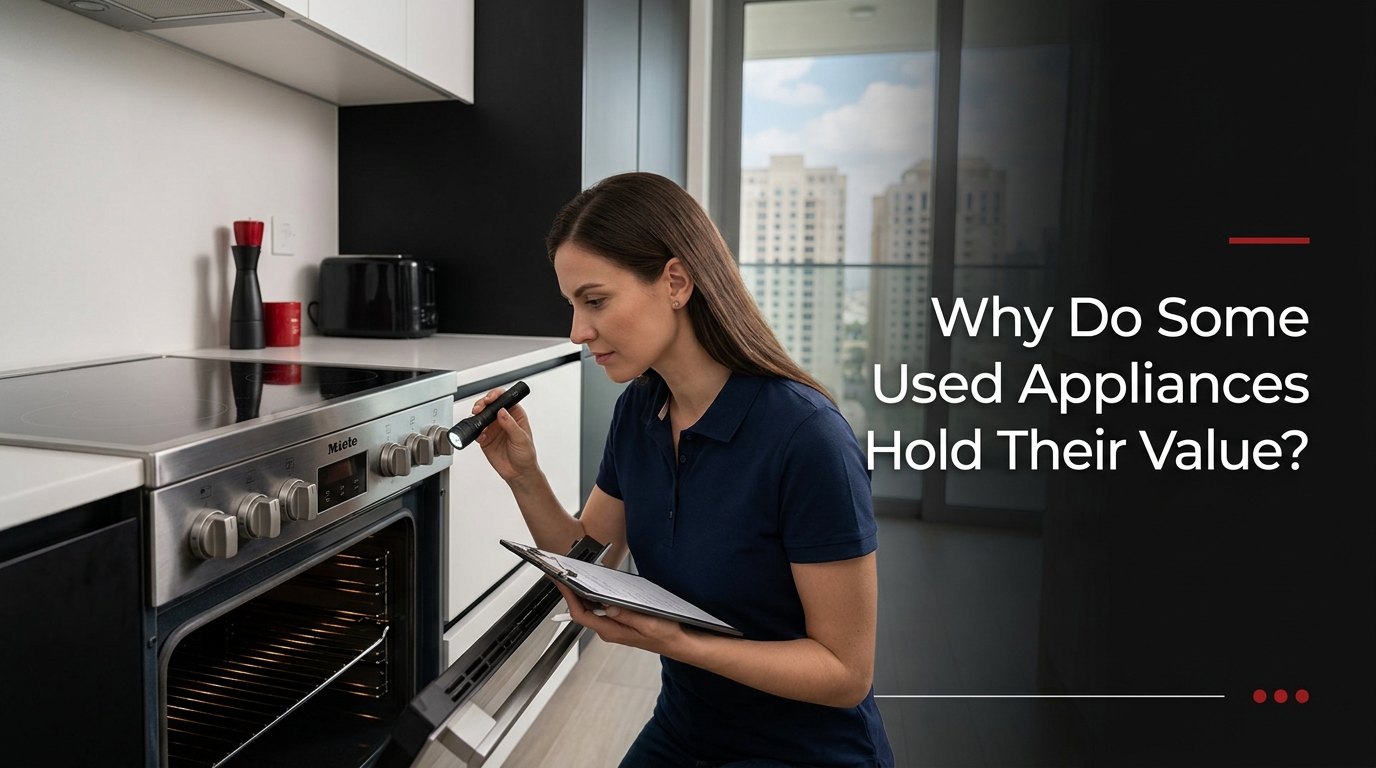
It’s a fair thing to notice: two appliances of similar age, doing the same basic job, can be listed at very different prices. A five-year-old washing machine from one brand might sell for a fraction of its original price, while a similarly aged appliance from another brand holds a surprising amount of its value. This isn’t random pricing it comes down to a specific set of factors that some brands and product categories simply have more of than others.
This article breaks down what actually drives sustained resale value, using Miele’s cooking ranges and dryers as examples of where this effect shows up clearly.
The Short Answer
Resale value holds up longer when an appliance combines build quality that genuinely lasts, strong parts and service availability years later and enough brand reputation that buyers specifically seek it out used, rather than treating it as interchangeable with any other option at a similar price point.
None of these factors alone fully explains it it’s the combination that keeps certain used appliances commanding a real price long after a comparable appliance from another brand would have dropped sharply in value.
Build Quality and Engineering Standards
Not all appliances are engineered to the same durability standard, even within the same category. Some manufacturers design and test components specifically for long-term reliability, rather than optimizing mainly for initial cost.
Miele is a clear example of this. The company states that its T1 tumble dryer series is tested for the equivalent of 20 years of use, based on running models and core components through 5,000 drying cycles during development a testing standard well beyond what’s typical for the category. This kind of engineering investment doesn’t disappear once the appliance leaves the factory; it’s part of why a well-maintained unit from a brand like this can still perform reliably a decade in, which buyers factor into what they’re willing to pay for it used.
Parts Availability and Long-Term Serviceability
This is a factor people often overlook: an appliance is only worth repairing and therefore worth buying used if parts and qualified technicians are still realistically available for it years later.
Brands with a strong, established service presence tend to hold value better for exactly this reason. A Miele cooking range, for instance a built-in oven such as the H2890B or a gas hob like the KM2052G, is backed by a manufacturer with dedicated authorized service support in the UAE, which means a buyer purchasing one used isn’t necessarily signing up for a difficult repair experience years down the line. Compare this to appliances from smaller or short-lived brands, where finding parts even five years after purchase can be genuinely difficult a real risk that pushes resale value down regardless of the appliance’s actual condition.
Brand Reputation and Niche Buyer Demand
Some brands attract buyers who are specifically looking for that name, not just any appliance in the category. This matters more for resale value than people expect.
A Miele dryer, for example, tends to attract buyers who already understand the brand’s reputation for durability and are specifically searching for a used Miele rather than comparing it purely against cheaper alternatives on a feature-for-feature basis. This kind of targeted demand keeps prices firmer than they would be for a brand where buyers are comparing purely on price and treating every option as interchangeable.
This effect compounds with supply. Premium brands are typically owned by fewer households to begin with, which means fewer used units come onto the market at any given time and when supply is limited relative to steady demand from buyers who specifically want that brand, prices hold up better than they would in a market flooded with used units from a common mass-market brand.
Why Cooking Ranges Specifically Hold Value Well
Cooking ranges and ovens, as a category, tend to depreciate more slowly than appliances with more moving parts and higher failure rates, like washing machines or dishwashers. A gas hob has relatively few components that wear out under normal use and a well-built oven’s core function heating evenly and reliably doesn’t really improve much between generations the way, say, smart features on a washing machine might.
This means a Miele cooking range that’s several years old is often still functionally comparable to a current model in the ways that matter most day-to-day, which supports its resale value more than a category where newer models offer a genuinely different experience.
Energy Efficiency Retention
A well-engineered appliance also tends to hold onto its efficiency rating better over time than one designed to a lower standard. An oven or dryer that was already highly energy-efficient when new continues to save on running costs for its owner years later, which is a real, ongoing value that buyers are willing to pay for even in a used unit unlike an appliance that was already inefficient new and only gets less efficient with age.
A Practical Comparison
Consider two dryers, both five years old and in good working condition: a mainstream budget model and a Miele T1-series heat-pump dryer, such as the TWD260WP.
The budget model likely sold new for a modest price and was one of many nearly identical units from several competing brands. Used examples of it are common, buyers aren’t specifically seeking that brand, and there’s little to differentiate it from a dozen similar listings all of which pushes its resale price down toward a small fraction of its original cost.
The Miele T1 dryer, by contrast, was designed and tested to a higher durability standard from the outset, is backed by established local service support, and appeals to buyers who specifically want a Miele rather than treating the category as interchangeable. Even at five years old, it’s likely to retain meaningfully more of its original value not because “Miele” is a magic word, but because each of the factors already discussed (build quality, serviceability, brand-specific demand) applies concretely to this example.
This is the practical version of the explanation: it’s not that expensive brands are simply priced higher out of prestige it’s that several real, checkable factors are usually present together, and they compound rather than working independently. A buyer weighing two similar-looking used dryers is really weighing this whole bundle of factors, whether they consciously break it down that way or not.
Common Misconceptions About Used Appliance Pricing
“An older appliance should always be cheap.” Age is one input, not the whole equation. A well-built, well-serviced appliance ages differently than one that wasn’t designed for longevity, and pricing should reflect that difference rather than treating all appliances as depreciating at the same rate.
“If it’s expensive used, someone is overcharging.” Not necessarily. A price that looks high relative to age can still be a fair reflection of genuine remaining value, particularly for a brand with strong parts availability and real buyer demand.
“New appliances are always a safer bet than paying more for a used premium one.” This depends on the specific comparison. A well-maintained used premium appliance with years of documented reliability can be a safer bet than a brand-new appliance from a brand with a shorter track record, depending on what you’re comparing it to.
“Brand name alone explains the price difference.” Brand reputation matters, but it’s really shorthand for the underlying factors testing standards, materials, service networks rather than a standalone reason on its own. A brand name without those factors behind it wouldn’t hold value the same way.
Does This Mean You Should Always Pay More for a Premium Used Brand?
Not necessarily it depends on what you actually need. If a mainstream brand’s mid-range oven or dryer covers your household’s needs perfectly well, paying a premium for a used Miele unit mainly buys you the engineering, service backing, and resale-value stability described above, rather than a dramatically different cooking or drying result on a day-to-day basis.
Where it tends to make more sense is if you’re planning to keep the appliance for many years, you value the lower likelihood of major repairs, or you’d like the option to resell it later without a steep drop in value all genuine advantages of buying into a brand with strong sustained demand.
How to Judge Whether a Premium Used Price Is Actually Fair
Rather than relying on brand reputation alone, a few concrete checks help judge whether a used listing’s price reflects genuine value:
- Ask about service history. An appliance with documented maintenance is a stronger bet than one with an unknown history, regardless of brand.
- Check current parts availability, not just whether the brand is generally well-regarded a discontinued model from an otherwise reputable brand can still be harder to service.
- Compare against genuinely equivalent models, not just similar-looking ones. A basic entry-level unit and a higher-tier model from the same brand can have very different resale trajectories.
- Factor in remaining lifespan, not just condition today a five-year-old appliance from a brand built for 15+ years of use is a different proposition than a five-year-old appliance from a brand with a shorter typical lifespan.
What This Means If You’re Selling
If you own a Miele cooking range, dryer, or similar premium appliance, it’s worth having it properly evaluated rather than assuming it’s only worth a fraction of its original price simply because of its age. The same factors that keep these appliances in demand as used purchases build quality, parts availability, and brand reputation work in your favor as a seller too.
Hassan Brothers evaluates used appliances based on brand, age, and condition, which means a well-maintained premium-brand appliance is assessed on its actual merits rather than a flat depreciation rate applied regardless of what you own.
Call or WhatsApp Hassan Brothers to find out what your appliance Miele or otherwise might actually be worth.
Understanding the Real Drivers of Value
A used appliance’s price isn’t really about age alone it’s about how well it was built, how easily it can still be serviced, and how much genuine demand exists for that specific brand. Once you look at it through those factors rather than age in isolation, it becomes clear why some appliances hold their value years longer than others, and why a seemingly high price for a used unit can still be a fair one.
FAQs
1. Why do some used appliances cost more than others of the same age?
It comes down to build quality, how easily the brand can still be serviced years later and how much specific demand exists for that brand among used buyers, rather than age alone.
2. Does Miele actually test its appliances for long-term durability?
Yes. Miele states that its T1 tumble dryer series is tested for the equivalent of 20 years of use, based on running models through 5,000 drying cycles during development.
3. Why do cooking ranges hold their value better than washing machines?
Cooking ranges have fewer moving parts prone to failure, and their core function doesn’t change much between generations, so an older unit often performs comparably to a new one in day-to-day use.
4. Is it worth paying more for a used premium-brand appliance?
It depends on your needs if you plan to keep it long-term, value fewer major repairs, or want it to hold resale value later, a premium brand’s sustained value can be worth the higher upfront cost.
5. Does parts availability really affect resale value?
Yes. An appliance is only realistically worth buying used if parts and service are still available for it, which is a bigger factor for lesser-known or discontinued brands than for well-established ones.
6. Why does brand reputation matter more for some appliances than others?
Some categories attract buyers who specifically want a particular brand rather than comparing purely on price, which keeps demand and therefore resale value firmer for those brands.
7. Do premium appliances always cost more to buy used?
Generally yes, relative to their age but this reflects genuine factors like build quality and service support rather than arbitrary pricing.
8. How does energy efficiency affect an appliance’s resale value?
An appliance that was highly efficient when new tends to retain more of that efficiency over time, which adds ongoing value for the next owner beyond the appliance’s basic function.
9. If I own a Miele appliance, is it worth more than a similar-age appliance from another brand?
Often, yes assuming it’s in good condition the same factors that support Miele’s resale value as a used purchase work in your favor when selling it.
10. Should I get my premium appliance evaluated before assuming it’s not worth much?
Yes. An evaluation based on brand, age, and condition gives a far more accurate picture than assuming a flat depreciation rate regardless of what you own.